Tennis Elbow: Why It Keeps Coming Back
A lot of the tennis elbow patients we see have already been through this once. They rested it, it calmed down, they got back on the court, and a few months later the same ache showed up in the same spot. If that's been your pattern, it's worth understanding what's actually happening in the tendon, because it explains why rest alone rarely fixes it long term.
What's going on in the tendon
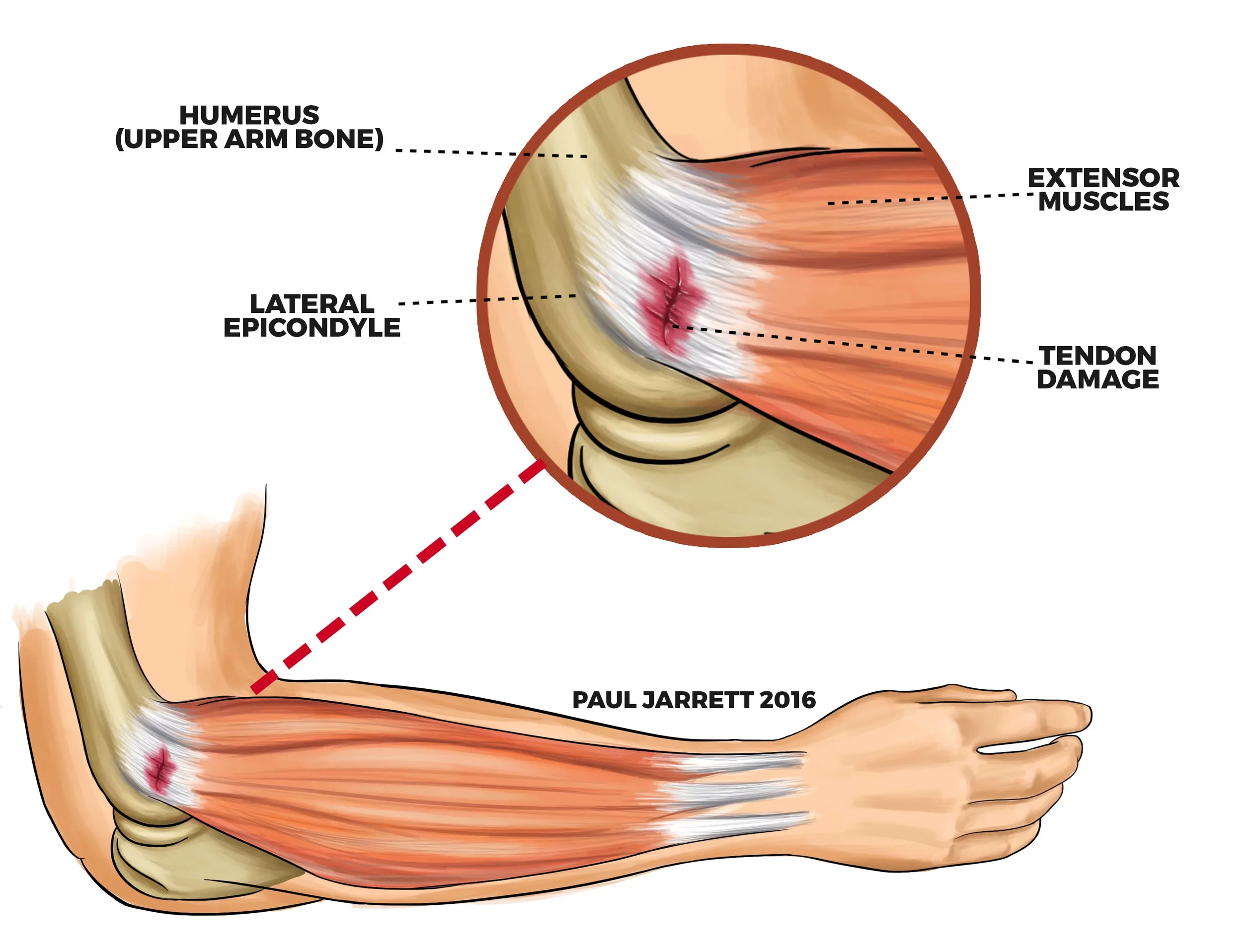
Tennis elbow, or lateral epicondylitis, involves the tendons that attach your forearm extensor muscles to the outside of your elbow. Under repeated loading, primarily from gripping and extending your wrist, the tissue develops disorganized collagen fibers and reduced blood flow at the attachment point.
This is a slow, degenerative process rather than a simple flare-up, which is why it can take months to settle and why symptoms return so easily once you go back to the activity that caused it in the first place.
Why it comes back
Three things usually drive the pattern of recurrence: the tendon tissue never fully remodels before play resumes, the repetitive stress that caused it in the first place continues unchanged, and the rest of the kinetic chain, wrist, forearm rotation, shoulder, and grip mechanics, keeps loading the elbow the same way it always has. Treating only the sore spot on the elbow without looking at what's feeding into it is one of the most common reasons people end up back in this same conversation a year later.
Grip size & string tension
Two equipment details make a measurable difference in how much force reaches your elbow on every shot.
Grip size: a grip that's too small or too large forces you to squeeze harder to control the racquet, which increases torque transmitted straight to the tendon. A properly sized grip lets your hand stay slightly more relaxed through the stroke.
String tension: higher tension transmits more vibration and impact force to your arm on contact. Dropping tension, generally toward the lower end of your racquet's recommended range, lets the strings absorb more of that shock instead of your elbow.
Neither change is a fix on its own, but combined with addressing the tissue itself, they reduce the load that caused the problem to begin with.
Rehab that actually holds
Passive Resting tends to underperform compared to a structured, progressive loading program. The most consistent results come from exercises that combine eccentric and concentric loading of the wrist extensors with isometric holds, gradually increasing resistance over several weeks rather than jumping back into full-intensity play.
Where a lot of home programs fall short is stopping at the forearm. Because the elbow is downstream of the shoulder and scapula, rehab that also strengthens the rotator cuff and scapular stabilizers tends to hold up better than forearm exercises alone, especially for people whose tennis elbow has already come back once or twice.
So at Well Co, we pair our treatments with a few exercises that you can do at home to speed up your recovery.
How we treat it at Well Co
Our approach starts with a full assessment of the kinetic chain, not just the elbow, because grip mechanics, forearm rotation, and shoulder stability all factor into whether this resolves or returns. From there, treatment typically combines:
Active Release Technique to address the tissue quality and adhesions in the forearm extensors that keep the tendon from healing properly.
StemWave shockwave therapy, which has a solid base of research behind it for reducing pain and improving grip strength in lateral epicondylitis, particularly for cases that haven't responded to rest and stretching alone.
Chiropractic adjustment to address joint mechanics elsewhere in the chain that may be contributing to how load reaches the elbow.
A progressive loading program you do at home between visits, since the in-office work only holds if the tendon is also being rebuilt outside the clinic.
For a straightforward, more recent case, most patients start with an Elevated Treatment visit (30 minutes, 2 to 3 regions, ART and chiropractic plus one modality).
For elbow pain that's been recurring for months or longer, we typically recommend a Total Body Reset visit (60 minutes, 3 to 4 regions, ART, chiropractic, StemWave, and acupuncture), since chronic, repeat presentations usually need more than one region addressed in the same visit (wrist, elbow, shoulder, thoracic spine).
Outcomes vary depending on how long you've had symptoms and how much has changed about your play in the meantime, but most patients notice improvement within a few sessions once the full chain is being treated instead of just the elbow.
Book an appointment or see current pricing and package options at wellcochiropractic.com/prices.
Next up in this series: the shoulder pain that shows up after months of serving, and why it's often not actually a shoulder problem.
Sources: