The Big Toe's Role in Knee, Hip, and Low Back Pain
When someone comes in with knee pain, hip tightness, or low back discomfort, the big toe is rarely the first place anyone thinks to check. But the joint where your big toe meets your foot, the first metatarsophalangeal joint, plays a much bigger role in how your entire leg moves than its size would suggest.
The Windlass mechanism
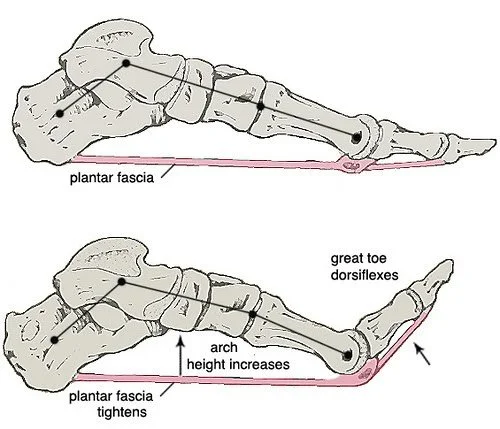
Every time you push off during walking or running, your big toe needs to bend upward, roughly 65 degrees in healthy gait, for the foot to work the way it's designed to. That motion winds the plantar fascia around the head of the first metatarsal, similar to a cable winding around a spool. As it winds, the fascia tightens, the arch rises, and the foot converts from a flexible shock absorber into a rigid lever you can actually push off of. That same motion also causes your shin bone to rotate outward slightly, which is a normal part of healthy push-off mechanics.
When the toe doesn't cooperate
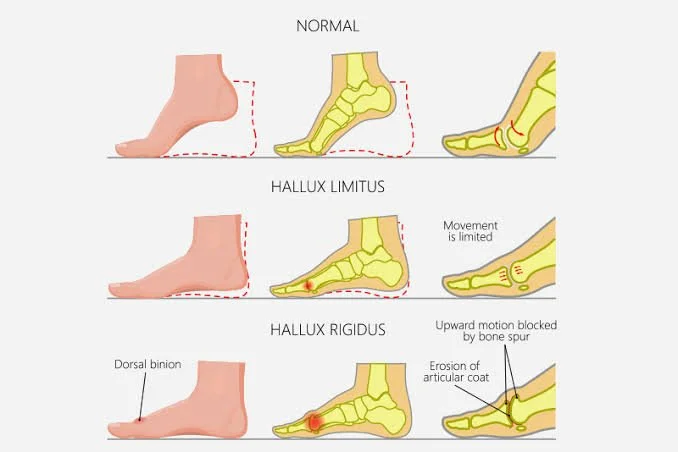
A condition called functional hallux limitus complicates this picture. The big toe can move through a full, normal range when you or your provider test it by hand, but still fail to extend properly during the split second it's actually needed during gait. That distinction matters clinically: a toe can look completely fine on exam and still be the root cause of what's happening further up the leg, which is exactly why it gets missed so often.
The cascade up the chain
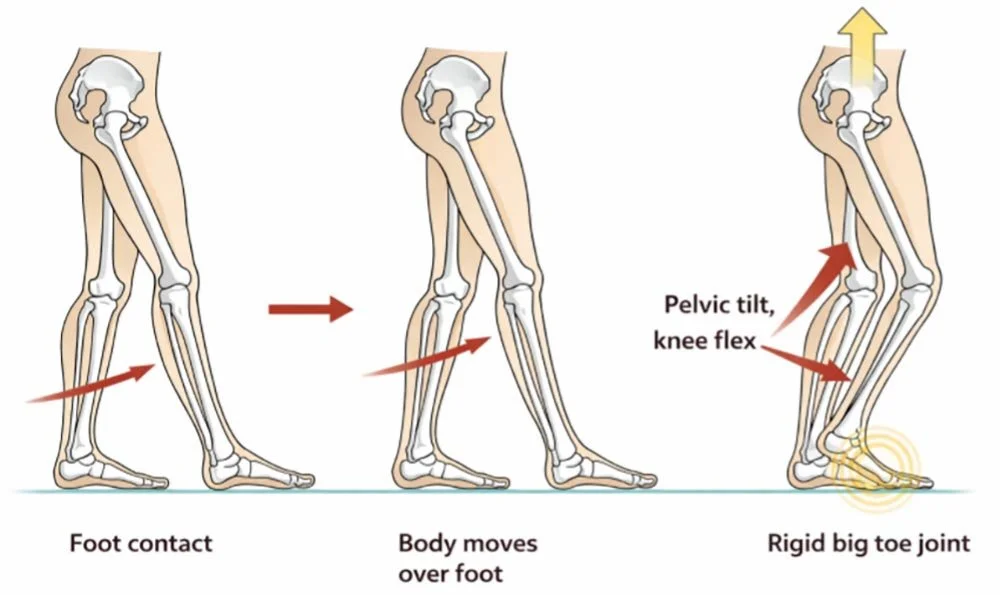
When the big toe can't do its job at push-off, the body doesn't just stop moving forward. It compensates, and those compensations show up at every joint above the toe.
At the ankle and calf, restricted big toe motion forces a reduction in ankle dorsiflexion as well. The calf works harder and shortens slightly with every stride, which is part of why chronic Achilles issues sometimes trace back to a stiff toe rather than the calf itself.
At the foot and lower leg, the body often compensates by rolling the foot outward or increasing internal rotation of the tibia, a component of what's often described as dynamic knee valgus, the inward collapse pattern associated with knee pain.
At the knee, this altered mechanics forces earlier and greater knee flexion during midstance, which disrupts normal quadriceps loading and increases stress at the kneecap with every single step.
At the hip and low back, restricted push-off forces an earlier heel rise and reduces hip extension late in the stride. The hip flexors end up working harder to make up for the lost push-off power, which frequently shows up as chronic hip flexor tightness or low back discomfort, particularly in people who walk or run any real volume.
Why this gets missed
Because the big toe itself is rarely painful in these cases, it's rarely examined directly. Most people end up treating the knee, hip, or low back where the pain actually shows up, without ever checking whether the real driver is a joint several segments away that never got assessed.
How we treat it at Well Co
First MTP (that big toe of yours) joint mobility is part of our standard assessment for knee, hip, and low back complaints, not an afterthought we get to if nothing else explains the pain. Treatment typically includes:
Active Release Technique and Graston to address restriction in the tissue around the big toe joint, including the tendons that cross it, which often tighten up over time as the joint loses motion.
Add in StemWave Shockwave Therapy for increased blood flow, decreased inflammation around the muscles, ligaments and tendons, and you’ve got a great regenerative therapy that will continue to work for days.
Chiropractic and joint mobilization of the first MTP joint and midfoot to restore the dorsiflexion range push-off actually requires.
Treatment of the knee, hip, or low back itself where the pain is showing up, since restoring toe mobility rarely undoes months or years of compensation on its own.
A home program specifically targeting big toe mobility, since this is one of the easier ranges of motion for patients to maintain between visits once it's restored.
Because this typically involves more than one region, the foot and wherever the pain is actually showing up, most of these cases fit better into a Total Body Reset visit (60 minutes, 3 to 4 regions, ART, chiropractic, StemWave, and acupuncture) than a single-region visit.
Book an appointment or see current pricing and package options at wellcochiropractic.com/prices.