Achilles Tendonitis: Causes, Symptoms & Treatment
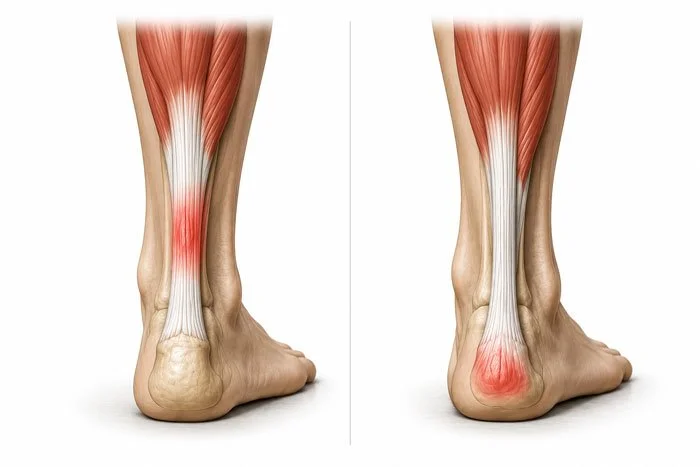
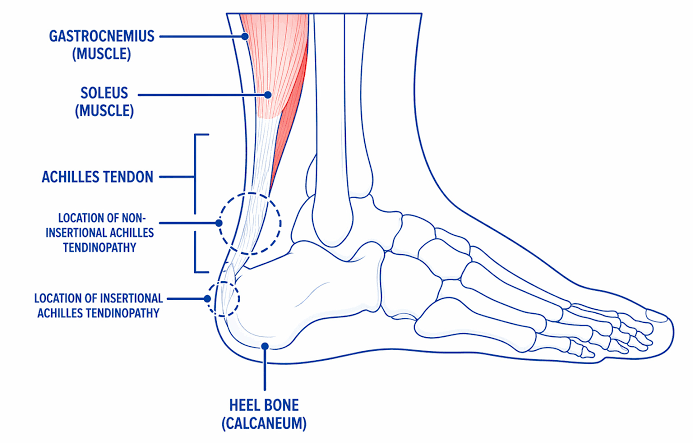
The Achilles tendon connects your calf muscles to your heel bone and does a disproportionate amount of work every time you walk, run, or jump. It handles several times your body weight with each stride, so it's no surprise it's one of the most common overuse injuries we see, particularly in people who run, play court sports, or have recently increased their activity level.
What causes it
Achilles tendonitis usually develops from repetitive strain rather than a single incident. Common contributors include a rapid increase in running or jumping volume, worn or poorly fitted shoes, training on uneven or hard surfaces, and tight calf muscles or flat feet that change how load is distributed through the tendon. Risk goes up with age, and it's more common in men and in anyone carrying extra body weight. Certain medications, quinolone antibiotics in particular, have also been linked to increased tendon injury risk.
Symptoms to watch for
Pain and stiffness along the back of the ankle, often worse first thing in the morning or after periods of rest, is the most common early sign. Swelling, tenderness to the touch, and a noticeably limited range of motion in the ankle often follow. Some people describe a popping or snapping sensation, which is worth getting evaluated promptly since it doesn't always mean a tear, but needs to be ruled out. Difficulty walking or running normally is common once symptoms progress.
How it's diagnosed
Diagnosis starts with a physical exam, checking for swelling, tenderness, and range of motion, along with a history of how and when symptoms started. Imaging like ultrasound or MRI can help confirm severity in some cases, but imaging findings frequently don't correlate well with how much pain someone is actually in or how their recovery will go, which is why a thorough physical exam matters more than a scan in most cases. Part of a good exam also involves ruling out conditions that can mimic Achilles tendonitis, including plantar fasciitis, a stress fracture, or a partial tendon tear.
Why rest alone doesn't fix it
Tendons heal through load, not the absence of it.
Movement creates a mechanical signal in the tendon that gets converted into the biochemical processes responsible for rebuilding tendon integrity. Resting completely might reduce pain temporarily, but without progressive loading, the tendon doesn't actually get stronger or more resilient, which is a major reason this injury tends to come back once people return to activity.
Eccentric loading, most established through the Alfredson heel-drop protocol, has the strongest evidence base for treating Achilles tendinopathy of any conservative approach. Structured eccentric programs have shown meaningful, lasting improvement in both pain and tendon structure over time, and isometric holds are often used early on to help manage pain before progressing into fuller loading.
How we treat it at Well Co.
Because the Achilles doesn't work in isolation, we assess the calf, ankle, and foot together, including big toe and midfoot mobility, since restrictions anywhere in that chain change how load reaches the tendon. Treatment typically includes:
A structured, progressive loading program, starting with isometrics if pain is high and advancing into eccentric and heavy-slow-resistance work as tolerated. This is the backbone of treatment and the piece most responsible for long-term results.
Active Release Technique and Graston to address restriction and tissue quality in the calf and surrounding tissue. This works best as a complement to the loading program rather than a standalone fix, since the evidence for manual therapy alone in tendinopathy is limited, but it can help reduce guarding and improve tissue mobility while the loading program does the structural work.
StemWave shockwave therapy, which has solid evidence behind it specifically for midportion Achilles tendinopathy and is frequently used alongside a loading program rather than in place of one.
Chiropractic adjustment to address ankle and foot joint mobility that may be limiting how well the tendon can be loaded through a full range.
Prevention
Warming up before activity, increasing training volume gradually rather than in large jumps, wearing shoes that fit and support your specific foot, and building genuine strength in the feet and calves all reduce risk meaningfully. Because the Achilles routinely handles multiples of body weight, it needs to be trained for that demand, not just stretched. Isometric calf holds are a simple, low-risk way to build some of that capacity even before symptoms start.
Depending on severity, most Achilles cases start with an Elevated Treatment visit (30 minutes, 2 to 3 regions, ART and chiropractic plus one modality), moving to a Total Body Reset (60 minutes, 3 to 4 regions, ART, chiropractic, StemWave, and acupuncture) for more chronic cases or when the surrounding kinetic chain, foot, ankle, and calf together, needs to be addressed in the same visit.
Book an appointment or see current pricing and package options at wellcochiropractic.com/prices.