Most plantar fasciitis treatment focuses entirely on the heel and arch: ice it, stretch it, rest it, maybe a night splint. That approach treats the foot like it's an isolated structure. It isn't. The connective tissue running through your body doesn't stop at your ankle or your knee. It runs in continuous lines from one end of you to the other, and understanding that is a big part of why some heel pain doesn't resolve no matter how much local treatment it gets.
Fascia doesn't stop at the joint
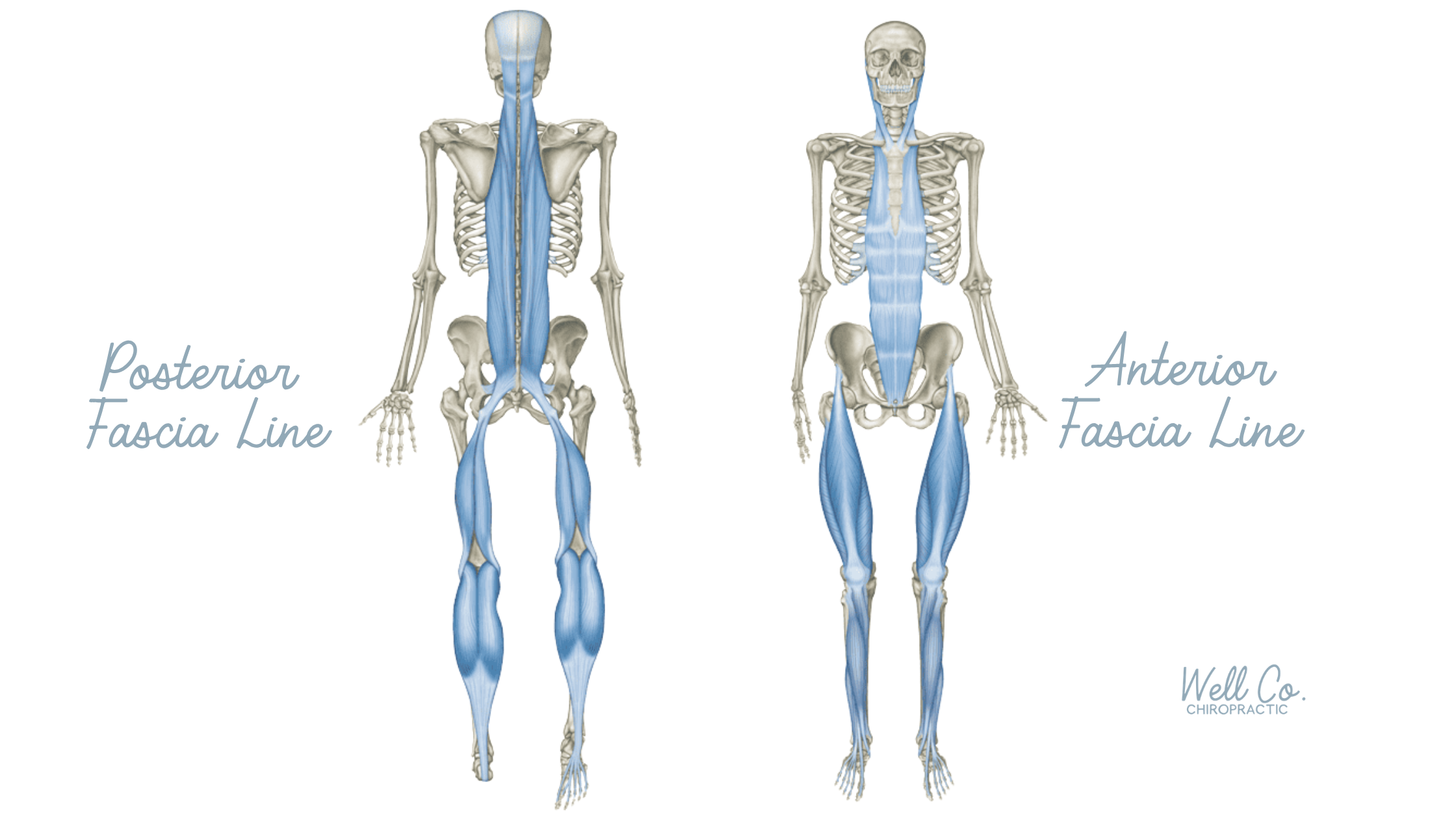
The fascial line most relevant to plantar fasciitis runs along the entire back of your body, starting at the bottom of your foot and continuing up to the base of your skull. Along the way, it passes through the plantar fascia itself, the small flexor muscle that runs under your arch, the heel bone, the Achilles tendon, the calf, and the hamstrings, all the way up past the back of the knee.
Because this tissue is continuous rather than segmented, tension or restriction anywhere along that line changes how load gets distributed at the other end of it. A tight, weak, or restricted hamstring can directly affect how much strain reaches your foot and ankle with every single step, even though the hamstring is nowhere near where the pain is.
What this means for heel pain specifically
A case study on dry needling for chronic plantar fasciitis found better outcomes when treatment addressed the entire posterior chain, from the foot up through the calf and hamstring, rather than only the local heel and arch area. It's a single case study, not a large trial, so it's more suggestive than definitive, but it lines up with what we see clinically: heel pain patients often need assessment and treatment in areas that have nothing to do with where they feel pain.
It’s a Group project.
When we explain to a patient why we're working on their hamstring for a heel problem, we usually use this comparison: picture a group project where one person is doing all the work while the rest of the team coasts. The heel, in a case like this, is that one overworked team member. Resting or icing it doesn't actually reduce its workload if nothing else has changed about how the rest of the chain is contributing. The goal of treatment is to get every part of that chain pulling its share of the load again, so the heel isn't left carrying all of it alone.
It's not only the back of the body
The back line isn't the only one that matters here. A front fascial line runs along the top of your foot, up the front of your body. During push-off, this line stretches and then recoils, which contributes a bit of free forward momentum, similar to a slingshot effect. Getting that stretch, and clearing your toes during the swing phase of your stride, both require adequate ankle bend.
There's also a lateral line running along the outside of the leg and hip, including the two peroneal muscles at the ankle, the hip abductors, and the side abdominal muscles. One genuinely counterintuitive finding from muscle activity research here: the glute max isn't actually the muscle driving your push-off the way it's often described. It's most active right around heel strike, where its job is controlling and decelerating the leg as it lands, not powering you forward. Push-off is driven much more by the calf and the foot itself.
And there's a deep line running through the core of the body, including the diaphragm, deep abdominal muscles, hip flexors, pelvic floor, and two muscles we've written about before, the tibialis posterior and the deep toe flexors. Even breathing patterns factor in here, since inefficient breathing affects the deep core and pelvic floor, which connect directly down into the same tissue supporting your arch. Restriction in an outer layer, tight quads being a common example, can also limit how well we're able to access and treat this deeper layer at all.
Two things that matter across all of it
Two factors show up repeatedly no matter which line we're talking about.
Range of motion: your body needs adequate range at each joint to move efficiently, and when range is limited somewhere, movement gets pushed into a narrower pattern than it should use, which changes how force travels through the rest of the chain.
Strength: tissue needs the capacity to actually handle the load being asked of it, particularly foot strength at push-off, and overall strength is one of the strongest predictors of long-term function and quality of life as we age.
How we treat it at Well Co
For plantar fasciitis, our assessment starts at the foot but doesn't stop there. We look at hamstring and calf capacity, ankle mobility, and the strength of the muscles that support your arch (the tibialis posterior, tibialis anterior, and peroneus longus we've covered before), because any of these can be feeding the problem at the heel. Treatment typically combines local work on the fascia itself, including StemWave shockwave therapy, with Active Release Technique and Graston addressing tissue quality further up the chain in the calf and hamstrings, chiropractic adjustment for joint mobility, and a home program built around both range of motion and strength rather than just the painful spot.
Because this approach spans more than one region by design, most plantar fasciitis cases here fit better into a Total Body Reset visit (60 minutes, 3 to 4 regions, ART, chiropractic, StemWave, and acupuncture) than a single-region visit, since treating the whole chain in one session is the point, not an add-on.
Book an appointment here or see current pricing and package options at wellcochiropractic.com/prices.