Shoulder Pain From Serving: The Kinetic Chain Connection
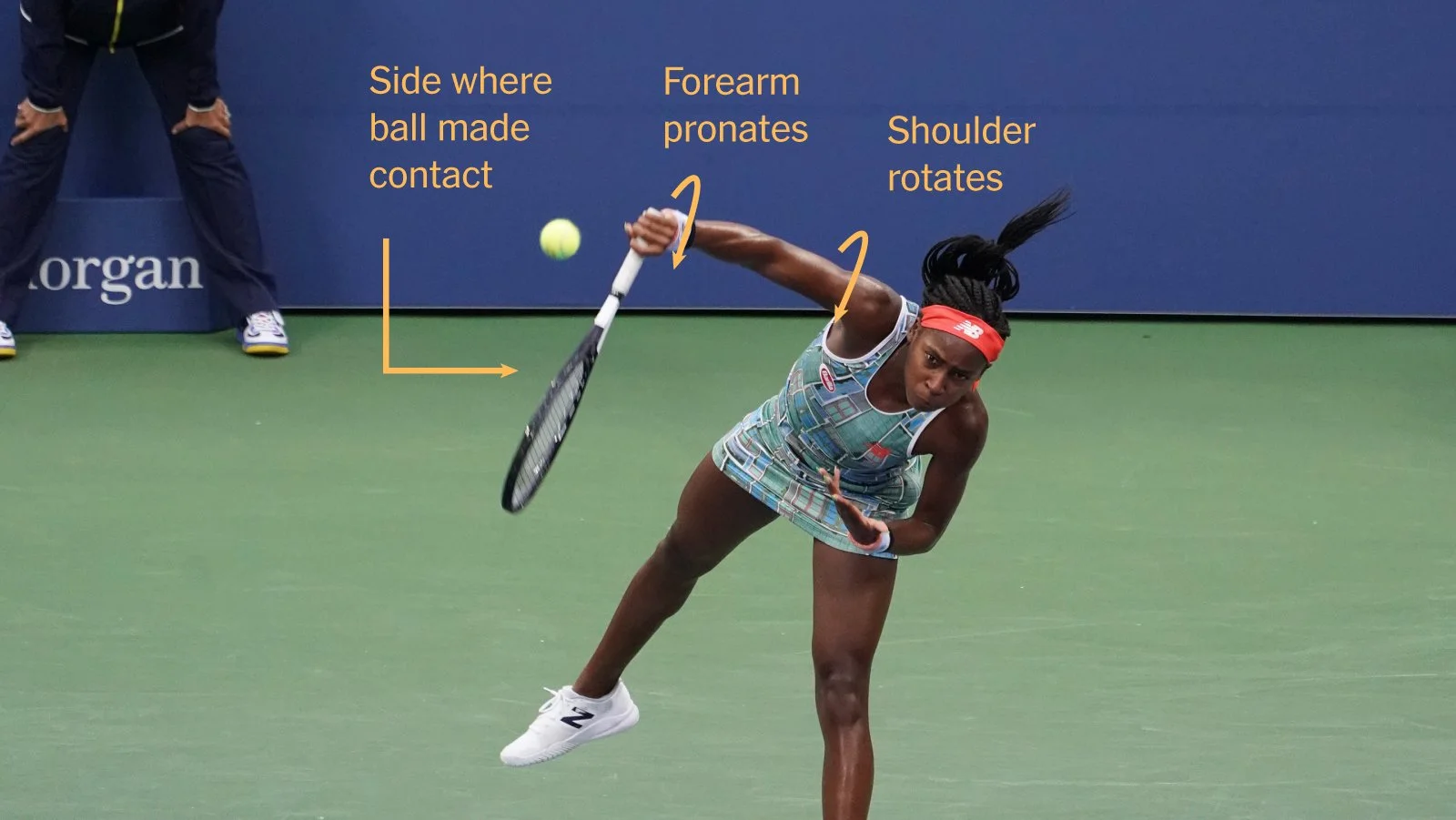
Most players who come in with a sore shoulder after months of serving assume the fix lives in the shoulder. Ice it, rest it, maybe some shoulder exercises. But the shoulder only generates about 13% of the total kinetic energy delivered through a serve. Your legs and trunk generate 51 to 55% of it. When that lower chain isn't doing its share, the shoulder makes up the difference, swing after swing, and that's usually where the real problem starts.
The math behind the overload
Research on serve mechanics puts a number on this: a 20% drop in kinetic energy delivered from the hips and trunk requires a 34% increase in shoulder rotational velocity to produce the same force to the hand. That's not a small compensation. If your trunk rotation is firing late, or your hip drive has quietly gotten weaker over the years, your shoulder is working substantially harder on every single serve to make up for it, whether you feel it happening or not.
What gets injured in the shoulder
A few patterns show up consistently in tennis players with shoulder pain:
→ Rotator cuff tendinopathy and impingement, often from the tendon repeatedly contacting the back of the shoulder socket during the cocking and acceleration phases of the serve.
→ GIRD, or glenohumeral internal rotation deficit, where the shoulder gradually loses internal rotation range while external rotation increases. This is common in players who've served for years and changes how the joint moves under load.
→ Scapular dyskinesis, meaning the shoulder blade isn't moving and stabilizing the way it should. This one matters more than people expect. It's been linked to as much as a 43% higher risk of shoulder pain in overhead athletes.
Where it starts
When trunk rotation sequencing breaks down, whether from a weak or unstable core, tight hips, or just accumulated fatigue, the shoulder and elbow pick up the mechanical slack. That's the piece that gets missed in a lot of shoulder-only treatment: the joint hurting isn't necessarily the joint driving the problem.
What helps
Addressing GIRD with scapula-stabilized posterior capsule stretching (a modified sleeper stretch or cross-body stretch) has shown consistent improvement in both pain and internal rotation range in overhead athletes over a few weeks of regular use.
A graded exercise program for the scapular stabilizers tends to outperform shoulder-only strengthening, especially for players dealing with impingement-type pain.
Rebuilding hip and trunk rotation strength and mobility so the shoulder isn't compensating for a chain that's underperforming further down.
How we treat it at Well Co
We start by assessing the full chain, hips, trunk, scapula, and shoulder, rather than treating the shoulder in isolation, since the research is fairly clear that the source of the overload is often somewhere else entirely. Treatment typically combines:
Active Release Technique for the rotator cuff and scapular stabilizer tissue quality, which tends to be restricted in players who've been compensating for months.
StemWave shockwave therapy, which has strong evidence behind it for calcific rotator cuff tendinopathy specifically. For non-calcific cases, the evidence is more mixed on its own, but it performs well combined with manual therapy and a loading program, which is how we typically use it.
Acupuncture, which has shown short-term pain relief and improved shoulder function for impingement-type pain, particularly when paired with an exercise program rather than used alone. Evidence quality is still building here, but it's a low-risk addition that helps manage pain while the loading work does the longer-term repair.
Chiropractic adjustment, particularly through the thoracic spine, since limited upper back mobility restricts how well the scapula can move and stabilize during the serve.
A home rehab program targeting hip and trunk rotation strength, not just the shoulder, since that's usually the piece driving the recurrence.
Because shoulder pain from serving is rarely confined to one region, most of these cases fit better into a Total Body Reset visit (60 minutes, 3 to 4 regions, ART, chiropractic, StemWave, and acupuncture) rather than a single-region visit, since the hips, trunk, and shoulder often all need attention in the same session.
Book a consultation here or see current pricing and package options at wellcochiropractic.com/prices.
Next up in this series: Achilles pain from tennis, and why it shows up more in players who've picked the sport back up after time off.
Sources: