Chronic Achilles Pain in Sarasota: Why It's Not Healing
Why Your Achilles Isn't Healing (And What Actually Fixes It)
If you've had Achilles pain for months, rested it, maybe had a cortisone injection, and it keeps coming back, there's a reason for that. The problem isn't that you haven't been patient enough. The problem is that rest and cortisone don't fix what's actually happening in the tissue. You got issues with those tissues.
It's Not Tendinitis. It's Tendi-NOSIS.
Most chronic Achilles presentations are not an inflammation problem. They're a degeneration problem. The correct term is tendinosis, and the distinction matters because it changes what treatment needs to do.
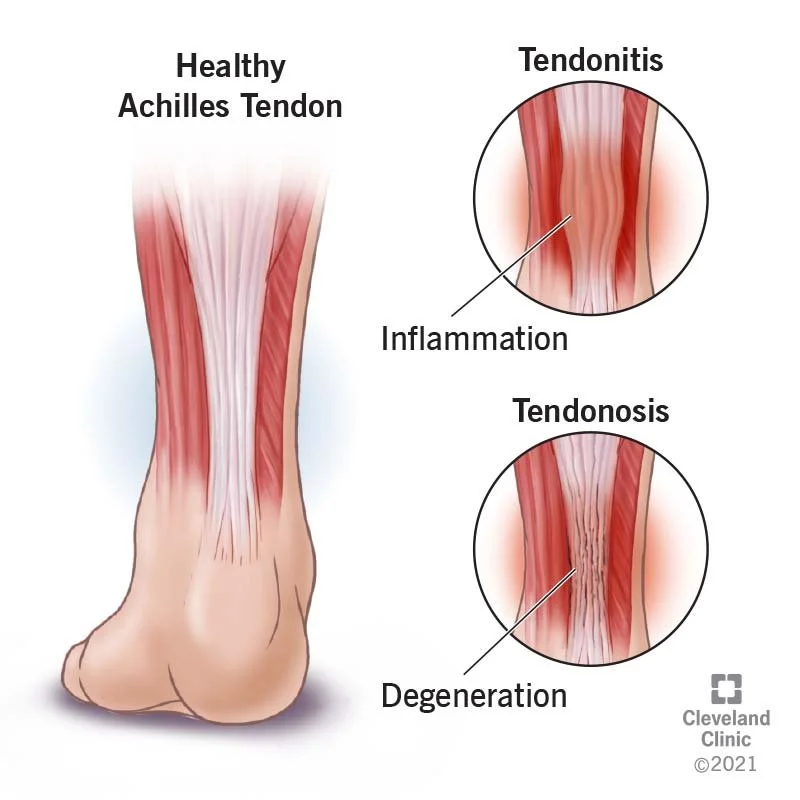
In an acute injury, inflammation is part of the healing process. But when Achilles pain has been present for months, the tissue has moved past that stage. What's happening instead is a breakdown in the tendon's structural integrity. The ratio of weaker Type III collagen increases relative to the stronger Type I collagen the tendon needs to function under load.
→ Tenocyte activity drops.
→ Fibroblast signaling becomes impaired.
→ Microtears accumulate without proper repair.
→ Blood flow in the region is already limited by the tendon's low baseline vascularity, which slows everything down further.
The pain itself is being driven by dysfunctional neurovascular ingrowth into the tendon, not by active inflammation. That's why anti-inflammatories provide temporary relief at best.
Why Common Treatments Fall Short
Rest alone does not stimulate collagen remodeling. The tissue becomes less symptomatic with reduced load, but the underlying structural problem remains. Return to activity, and the pain returns with it.
NSAIDs reduce inflammation, but chronic Achilles tendinopathy isn't primarily an inflammatory condition. They address a secondary feature while leaving the tissue degeneration untouched.
Cortisone injections are worth understanding clearly. They can reduce pain in the short term, but cortisone has been shown to further weaken tendon integrity. For a tissue that is already structurally compromised, repeated cortisone is working against long-term recovery.
Surgery carries a long recovery and doesn't address the upstream tissue biology that allowed the problem to develop.
What the Tissue Actually Needs
Achilles tendinosis requires two things: a stimulus to restart the repair process, and progressive mechanical loading to drive collagen remodeling and restore tensile strength.
At Well Co Chiropractic in Sarasota, we use StemWave focused shockwave therapy as the primary tool for the first part. StemWave delivers high-energy focused acoustic waves into the tendon tissue, targeting both the mid-substance and insertional regions depending on where the degeneration is concentrated. At the cellular level, it stimulates new blood vessel formation, activates fibroblasts to produce Type I collagen, recruits local stem cells, and downregulates the pain mediators driving symptoms. The goal is to convert a chronically non-healing tendon back into an actively healing one.
That biological stimulus is paired with eccentric loading, the most evidence-supported mechanical approach for Achilles tendinosis. Eccentric calf loading places the right kind of tensile demand on the tendon to drive collagen fiber alignment and build structural resilience. We also work on posterior chain mobility and, where relevant, gait mechanics, because how the foot and ankle load the tendon on every step matters for long-term outcome.
What to Expect
Most patients with chronic Achilles tendinopathy start noticing a shift within the first two to three weeks. Pain with first steps in the morning, stiffness after sitting, and discomfort during activity all tend to improve as the tissue responds to treatment. The timeline varies depending on how long the tendon has been symptomatic and how much structural change has occurred, but most cases resolve with a focused course of care rather than indefinite management.
If your Achilles has been painful for months and conservative treatment hasn't moved it, we're at 3982 Bee Ridge Rd, Sarasota, FL 34233. Book online at wellcochiropractic.com.